

How Music Supervisors Actually Find Songs in 2026 (And How to Get Discovered)
Executive Summary
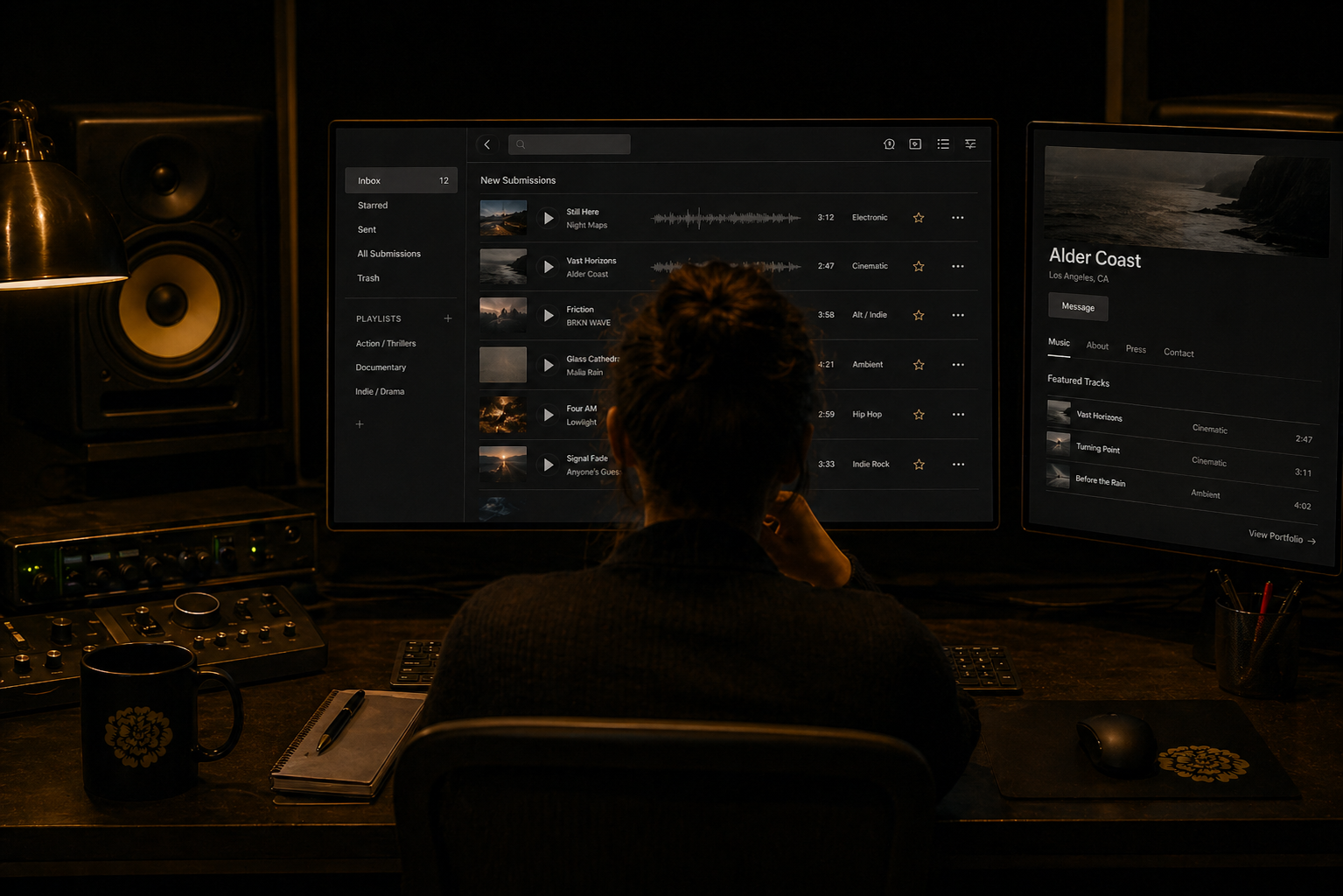
Music supervisors usually find songs through trusted music libraries, publishers, sync representatives, label contacts, private playlists, previous relationships, and carefully targeted pitches that match an active brief.
The songs that move fastest are not simply the best-sounding tracks. They are the tracks that are easy to search, easy to clear, and ready to deliver immediately. That means strong metadata, clear ownership, instrumental and clean versions, stems when requested, and a fast contact for licensing approval.
This guide shows independent artists and producers where music supervisors look for songs, what a real brief may require, and how to prepare a catalog that can actually be found and licensed.
Quick answer: If your music is searchable, professionally prepared, rights clear, and relevant to the opportunity, you are much easier for a music supervisor, publisher, or music library to trust.
Who This Guide Is For
This guide is for independent artists, producers, songwriters, and small catalogs trying to get music considered for TV, film, advertising, trailers, and games.
It is especially useful if you:
Have songs ready, but do not know where supervisors actually search.
Have submitted music before and received little or no response.
Need to organize metadata, rights information, and alternate versions.
Want to pitch smarter instead of sending random songs to random contacts.
This guide is not about spamming music supervisors. It is about preparing music that fits real opportunities and makes clearance easier when the right brief appears..
Table of Contents
Where Music Supervisors Actually Find Songs
How Music Supervisors Search by Genre, Mood, and Scene
What a Music Brief Can Look Like
Metadata Checklist for Sync Licensing
How to Make Your Music Discoverable and Sync Ready
What to Send in Your First Email
Exclusive vs Nonexclusive Music Libraries: What Artists Should Know
How to Pitch Music for Sync the Right Way
How to Research Music Supervisors by Genre
Common Mistakes That Keep Good Songs From Getting Considered
How to Fix Your Sync Licensing Strategy
Final Thoughts: Make It Easy to Say Yes
How Music Supervisors Actually Find Songs
Music supervisors usually aren't scrolling through random social media posts, hoping to stumble across the perfect song. Their job is to find music that supports a scene, fits the budget, clears properly and can be delivered on deadline.
That means they often begin with trusted sources where music is already organized, searchable, and ready for licensing.
Music supervisors commonly discover songs through:
Music libraries
Music libraries give supervisors access to searchable catalogs organized by genre, mood, tempo, lyrical theme, and possible scene use. For independent artists, libraries can be one of the most practical ways to get music into an organized discovery system.
Publishers and sync representatives
Publishers and sync agents often pitch music directly for active opportunities. Supervisors may trust these sources because the songs have already been organized, reviewed, and prepared for licensing.
Previous relationships
A supervisor who has received strong music, accurate files, and fast responses from an artist or catalog owner may return to that source again. Reliability matters because sync opportunities often move quickly.
Project briefs
A brief is a request for a specific type of song for a film, television show, advertisement, trailer, or game. Briefs may call for a genre, mood, lyrical theme, vocal style, tempo range, or reference artist.
Private playlists and personal catalogs
Sometimes a supervisor hears a song that does not fit a current project but saves it for a future opportunity. This is why organized contact information, clear metadata, and professional delivery still matter even when a song is not selected immediately.
Targeted direct pitches
Some supervisors, publishers and licensing companies accept carefully selected submissions. A short, relevant pitch can work when the music clearly fits the projects or genres they handle.
A music library is a powerful discovery path, but it is not the only way songs reach supervisors. The real goal is to make your music easy to find, easy to understand and easy to license wherever it is discovered.
Before sending music anywhere, make sure your catalog has clear metadata, alternate versions, and confirmed rights information. A strong song gets attention. A prepared song is easier to use.
Read our guide on how to build a sync-ready music catalog before you start pitching.
How Music Supervisors Search by Genre, Mood and Scene
Music supervisors are rarely searching for a song based on genre alone. They are usually solving a specific creative problem inside a scene.
A project may need music for a breakup, a celebration, a chase sequence, a family moment, a luxury product campaign, an emotional ending or a tense transition. The genre matters, but the mood and intended use matter just as much.
For example, a supervisor may not simply search for:
R&B
Hip hop
Pop
Gospel
Indie rock
They may search for something much more specific, such as:
Atmospheric R&B for a late-night drive scene
Reflective female vocal about moving on
Hopeful hip hop instrumental for an athlete documentary
Warm acoustic song for a family reunion moment
Confident trap instrumental for a luxury fashion campaign
Emotional gospel-inspired vocal for a redemption scene
Suspenseful instrumental with no vocals for a crime drama
This is why artists should describe their songs in a way that connects the sound to a possible scene.
Labeling a track only as “R&B” does not tell a supervisor enough. Labeling it as “intimate alternative R&B with soft drums, warm keys and reflective breakup lyrics” gives the track more context and makes it easier to match with a visual moment.
When organizing your songs, think beyond genre and include:
Primary genre
Secondary genre or influence
Mood
Energy level
Vocal style
Instrumentation
Lyrical theme
Tempo or BPM
Clean or explicit status
Possible scene uses
Available alternate versions
For artists searching for music supervisors by genre, this is an important shift. Do not only look for people who work with “hip hop” or “R&B.” Look for supervisors, libraries, and publishers whose recent projects use the type of emotion, storytelling, and scene placement your songs naturally support.
The Channels Supervisors Use to Discover Music
Every placement starts with a brief.
A brief is a detailed request describing the type of song needed for a scene. It might include emotional tone, genre, tempo, and even reference tracks. For example, a brief might call for an upbeat, emotional pop record that feels uplifting but not overly commercial.
Once that brief is defined, the music supervisor moves into search mode. They are not browsing randomly. They are filtering.
Inside a production music library, they will search using phrases like uplifting indie pop, dark cinematic tension, or emotional piano instrumental. These searches are powered entirely by metadata for sync licensing.
This is where most artists lose before they even start. If your track is not labeled correctly, it does not appear in these searches. It is not that your music is bad; it is that your music is invisible.
Understanding how music supervisors search is one of the most important steps in learning how to get your music placed in TV and film. You are not just creating songs; you are creating searchable assets.
What a Music Brief Can Look Like
A music brief is a request for a specific type of song to support a scene, campaign, or creative direction. It tells artists, publishers, libraries, or sync representatives what kind of music may fit the opportunity.
A brief may be detailed or very short. It may name a genre, mood, vocal preference, lyrical direction, reference sound, clearance requirement, and delivery deadline.
Example of a music brief:
Project type: Television drama episode
Scene: The main character drives home alone after realizing a relationship is over.
Music direction: Atmospheric alternative R&B with emotional vocals.
Mood: Reflective, vulnerable, and intimate, but not completely hopeless.
Vocal preference: Female vocal preferred; instrumental version available.
Sound: Modern production, warm keys, soft drums, and cinematic space.
Lyrics: Themes of release, distance, acceptance, or starting over.
Rights preference: Clear ownership information and simple licensing approval.
Required files: Full version, instrumental version, and clean version if needed.
Deadline: Same-day submission.
Now imagine three artists, each with a song that fits the emotional tone of the scene.
The first artist sends a streaming link with no information about ownership or available versions.
The second artist sends a strong song and an instrumental, but no clear licensing contact or publishing information.
The third artist sends a private listening link with the full version, instrumental version, clean version, song metadata, and clear rights contact information.
All three songs could be good creatively. But the third song is easier to seriously consider because the supervisor can quickly understand what it is, how it fits, and who can approve the license.
That is the difference between simply having good music and having music prepared for sync.
Metadata Checklist for Sync Licensing
Metadata is the information attached to your song that helps music supervisors, publishers, and licensing companies understand what they are hearing and whether it can be used.
Strong metadata makes your music easier to search, pitch, and clear if an opportunity arises.
Every song you prepare for sync should include the following information.
Basic song information:
Official song title
Artist name
Featured artist name, if applicable
Writer names
Producer name, if relevant
Release status
Explicit or clean status
Song duration
BPM, when available
Creative search information:
Primary genre
Secondary genre or influence
Mood
Energy level
Instrumentation
Vocal style
Lyrical theme
Similar scene uses
Keywords that describe the song accurately
For example, instead of labeling a song only as “Hip Hop,” you may describe it as:
Cinematic southern hip hop with confident male vocals, heavy drums, and motivational lyrics for sports, training, or success-driven scenes.
Rights and clearance information:
Master recording owner
Publishing owner
Writer split percentages
Performing rights organization information
Licensing contact name
Licensing contact email
Whether the song is one-stop controlled
Whether samples have been cleared
Whether any approvals are required before licensing
Versions available:
Full version
Instrumental version
Clean version
No vocal version
Alternate mix
Stems, when requested
Short edit, when available
The purpose of metadata is not to make your submission look complicated. It is to remove questions before they slow down an opportunity.
When a supervisor finds a song that fits a scene, they should not have to chase down basic information about the writers, ownership, available versions, or who can approve the use.
Recommended internal link: Use our comprehensive sync licensing checklist before submitting music to ensure your songs are properly prepared.
How to Make Your Music Discoverable and Sync Ready
Getting discovered in sync is not only about knowing the right people. Your music has to be organized in a way that makes it useful when the right person hears it.
A music supervisor, publisher, or licensing company may have a very short amount of time to review options. If your song sounds strong but the files are incomplete, the ownership is unclear or the metadata is missing, another track may become the easier choice.
Before pitching your music, make sure each song has:
A professional full mix that sounds competitive beside commercially released music
A clean master with no avoidable technical issues
An instrumental version
A clean version when the lyrics require it
A no-vocal or reduced-vocal version when it makes sense for the song
Stems available if an editor or supervisor requests them
Clear and consistent file names
Accurate genre, mood, and scene keywords
Writer and ownership information
A licensing contact who can respond quickly
Confirmed sample clearance
A professional private listening link
Your song should also answer these questions quickly:
What type of scene could this music fit?
What emotion does it create?
Are there lyrics that could interfere with the intended use?
Is a clean version available?
Is an instrumental available?
Who owns the master?
Who controls the publishing?
Can the song be cleared without confusion?
Who should be contacted if a supervisor wants to license it?
Simple file preparation example:
For one sync-ready song, your folder may include:
Song Title Full Mix
Song Title Instrumental
Song Title Clean Version
Song Title No Vocal Version
Song Title Stems Folder
Song Title Metadata Sheet
Do not wait for someone to ask for these basics before preparing them. A brief may have a same-day deadline, and the artists who are already organized have a better chance of moving quickly.
A larger contact list will not fix an unprepared catalog. Prepare the songs first. Then pitch them to the right opportunities.
What to Send in Your First Email
Your first message should make it easy to say yes. Keep it short, include one link to a small playlist of the right vibe, and confirm you control the rights. If they like it, the next step is clearance, which is why it’s important to indicate you have full control of the rights to the music you’re pitching.
Ready to Stop Guessing Where to Pitch Your Music?
Get instant access to 300+ music supervisors, sync libraries, publishers, and licensing contacts. We did the research so you can build your pitch list, submit smarter, and get your music in front of the people placing songs in film, TV, ads, games, and music libraries.

Sync Licensing Bible directory for artists researching music supervisors, publishers and music libraries for film and TV placements.

The Sync Licensing Bible gives artists, producers, songwriters, managers, and indie labels access to over 300 music supervisors, music libraries, publishers, licensing companies, and sync contacts so you can stop searching and start pitching with a real plan.
This directory is designed to save you time, help you stay organized, and give you a stronger starting point for getting your songs in front of people who work with TV, film, ads, trailers, games, and digital media.
Perfect for anyone ready to stop guessing where to send music and start building a real sync outreach system.
Digital download only. No physical product will be shipped.
Exclusive vs Non Exclusive Music Libraries: What Artists Should Know
Music libraries can provide artists with a structured way to pitch songs to supervisors, editors, advertisers, and production teams seeking licensable music.
Before submitting your catalog, it is important to understand whether a library operates exclusively or nonexclusively.
Exclusive music libraries
An exclusive library may require the right to represent a specific song, a collection of songs, or a part of your catalog without competing representation from another company.
This can be useful when the library actively pitches music and keeps its catalog tightly organized. It can also make clearance simpler because one company knows exactly what it represents.
Before agreeing to an exclusive relationship, confirm:
Which songs are included
Whether the agreement controls the master, publishing, or both
How long does the agreement last
Whether the agreement renews automatically
Whether you can remove songs later
How income and royalties are reported
Whether you are still allowed to pitch the music independently
Nonexclusive music libraries
A nonexclusive library may allow you to place the same song in more than one catalog or continue pitching it through other opportunities.
This can give artists more flexibility, especially while building relationships and testing which companies produce actual opportunities.
However, flexibility also creates responsibility. You must keep detailed records of where each song is represented, who has access to it, and whether any later agreement conflicts with earlier submissions.
Before submitting to a nonexclusive library, confirm:
Whether you keep the ability to pitch the same track elsewhere
Whether the library requires specific metadata or file versions
Whether there are any restrictions after a placement
How licensing activity is reported
How payments are handled
Whether your song could appear through multiple sources in the same pitch process
Direct pitching and independent catalog ownership
Some artists choose to maintain full control of their music and pitch selected opportunities directly to supervisors, publishers, production companies, or licensing representatives.
This gives you more control, but it also means you are responsible for organizing your catalog, researching contacts, preparing every file, and responding quickly when opportunities arise.
There is no single correct choice for every artist. An exclusive relationship, nonexclusive strategy, or direct-pitching approach can all make sense depending on your catalog, goals, and how actively you want to manage the business side of sync.
Read every agreement carefully before placing music anywhere. A good opportunity should help your catalog move forward without creating confusion about who controls your songs.
How to Pitch Music Without Spamming
Finding music supervisors by genre only helps when the music you send genuinely fits their projects. A strong pitch is not a mass email with ten random tracks attached. It is a relevant introduction built around a specific musical fit.
A good pitch should include:
A short introduction with your name and role.
One sentence explaining why the music is relevant.
A private listening link to one to three appropriate songs.
A short note confirming available versions, such as instrumentals and clean edits.
Clear rights and clearance information.
A polite close without repeated follow-ups.
Sample Pitch Structure
Subject: Atmospheric R&B Songs for Reflective Drama Scenes
Hello [Name],
I am reaching out with three atmospheric R&B songs that may fit reflective drama, late-night drive, or relationship-focused scenes. Each track has a full mix, instrumental, and clean version available, with clear licensing information prepared.
Listening link: [Insert private catalog link]
Thank you for your time and consideration.
[Your Name]
[Contact Information]
Important Note
Only send music that matches the opportunity, supervisor or catalog you researched. Relevant pitching builds trust. Random pitching makes future emails easier to ignore.
Supe Troop advises against attaching audio files directly to submission emails and emphasizes properly labeled delivery with metadata included.
How to Research Music Supervisors by Genre
Finding a list of music supervisors is not enough. You need to identify the people, publishers, libraries, and licensing companies that regularly work with the kind of music you actually create.
An artist making cinematic gospel, alternative R&B, aggressive trap instrumentals, and indie acoustic folk should not use the same pitch list for every song.
Your goal is to match your catalog with the projects, scenes, and musical needs that already make sense for it.
Start by defining your own catalog
Before researching contacts, write down:
Your primary genres
Your strongest moods
The types of scenes your music fits
Whether your songs are vocal or instrumental
Whether you control the master and publishing
Whether clean versions and instrumentals are ready
Whether your catalog is suitable for television, film, advertising, trailers, sports, games, or reality programming
Then, research supervisors and companies use these questions:
What recent projects have they worked on?
What genres appear in those projects?
Do they use songs similar in tone or emotion to yours?
Do they work in television, film, advertising, gaming, or trailers?
Do they accept music directly from artists?
Do they prefer submissions through music libraries, publishers, or representatives?
Are they looking for one-stop music or music with simple clearance?
Is there a professional submission method listed?
Does your song genuinely fit their recent work?
Search by genre and scene fit
Instead of only searching for “music supervisors accepting music,” make your research more specific.
For example:
Music supervisors for independent R&B artists
Music libraries accepting southern hip hop instrumentals
Sync licensing companies for gospel and inspirational music
Music supervisors working on reality television and lifestyle programming
Music libraries accepting cinematic trap instrumentals
Publishers seeking alternative pop for television placements
The closer your research matches your actual catalog, the more useful your pitch list becomes.
Research before you pitch
Do not send a song simply because you found an email address. Take a few minutes to confirm that the contact handles work-related to your sound, that submissions are welcome, and that your song is properly prepared.
A relevant pitch shows respect for the person receiving it. A random mass submission only makes your music easier to ignore.
For artists with an organized catalog, the Sync Licensing Bible can help create a starting list of supervisors, libraries, and publishers to research further before submitting music.
What Nobody Tells You About Sync Licensing
Here is the reality that most artists do not hear.
Sync licensing is not about one big placement, but about building a system that produces consistent opportunities.
Music supervisors are not searching for the most creative song. They are searching for the most usable one. The one that fits the brief, is easy to license, and can be delivered quickly.
This means the artists who win are not just talented. They are organized, prepared, and consistent.
Common Mistakes That Keep Good Songs From Getting Considered
Many songs fail to gain traction in sync licensing for reasons unrelated to creativity. A strong track can still be difficult to place when the files, rights or pitching strategy create unnecessary problems.
Mistake 1: Using vague genre labels
Labeling a song only as “pop,” “hip hop,” or “R&B” does not give enough context for a scene-based search.
Fix: Add accurate descriptions of mood, energy, lyrical theme, instrumentation, and possible scene use.
Mistake 2: Missing ownership information
A supervisor cannot move confidently on a song when it is unclear who controls the master recording or publishing rights.
Fix: Prepare writer splits, master ownership, publishing control, and a clear licensing contract before pitching.
Mistake 3: Not preparing alternate versions
A song may fit creatively, but it can be harder to use if there is no instrumental, clean edit, or alternate version available.
Fix: Prepare the full mix, instrumental, and clean version in advance. Add stems and alternate mixes when they are useful for the song.
Mistake 4: Pitching music to the wrong people
A great song sent to someone who does not work in your genre, scene, or submission type is still an irrelevant submission.
Fix: Research recent projects, genre patterns, and submission policies before reaching out.
Mistake 5: Sending large audio attachments
Unexpected attachments create friction and may never get opened.
Fix: Use a professional private listening link with clearly labeled tracks and easy access to metadata.
Mistake 6: Pitching songs before the mix is ready
Sync music is often reviewed alongside professionally produced commercial releases. A rough mix, weak vocal balance, or poor mastering can immediately limit the song’s chances.
Fix: Make sure your music is professionally mixed, mastered, and deliverable before expanding your outreach.
Mistake 7: Using uncleared samples
A sample that is not cleared can stop a placement even when the song fits perfectly.
Fix: Confirm sample clearance before submitting the track, or avoid using uncleared material in songs intended for sync.
Mistake 8: Sending mass emails with no relevance
Sending the same generic message and random catalog to a large contact list rarely builds trust.
Fix: Pitch fewer songs to better match opportunities. Explain briefly why the music fits the person, project, or catalog you are contacting.
Mistake 9: Responding slowly when there is interest
Music opportunities can move quickly. A supervisor may have several strong options ready to go.
Fix: Keep your files, metadata, and contact information organized so you can respond professionally when an opportunity appears.
Mistake 10: Treating a contact list like a guaranteed placement
Finding contacts is only one part of the process. A directory cannot replace strong music, proper clearance, accurate metadata, and respectful pitching.
Fix: Use contact research as the final step after your catalog is truly ready.
A Simple 7 Step Plan to Become More Discoverable
Choose your strongest three to five songs for sync pitching.
Confirm ownership, publishing splits, and any sample clearance issues.
Create full mixes, instrumentals, clean versions, and any useful alternates.
Add complete metadata, including mood, genre, BPM, writers, rights, and contact information.
Organize the songs in a professional private playlist or catalog.
Research libraries, publishers, and supervisors whose needs match your genre.
Pitch only when the music and the opportunity genuinely align.
A bigger contact list does not fix an unfinished catalog. Prepare the music first, then use research and outreach tools to find the right path into real opportunities.
Final Thoughts: Make It Easy to Say Yes
Music supervisors do not simply need great songs. They need songs they can find, understand, and deliver under real deadlines.
That means your best opportunity is not to send more random pitches. It is to build a catalog that is organized, professionally prepared, and relevant to the people searching for music like yours.
Prepare the metadata. Create the alternate versions. Confirm your rights. Research the correct contacts. Then pitch with a reason.
When the right opportunity arises, the goal is simple: make your music the easiest, strongest option to say yes to.
Prepare Your Catalog. Then Pitch Smarter.
Your music deserves more than random submissions and unanswered emails. Use the Sync Licensing Bible to build a targeted outreach list of music supervisors, libraries, publishers and licensing contacts after your songs are properly prepared for sync.
FAQs
-
To get your music placed in TV and film in 2026, you need more than just a great song. You need properly mixed and mastered tracks, strong metadata for sync licensing, and versions like instrumentals and clean edits. Most placements happen through a production music library or direct pitching to a music supervisor, so your music must be easy to search, easy to license, and ready to use immediately
-
Sync licensing is when your music is licensed to be used in visual media like TV shows, films, commercials, or streaming content. For independent artists, this usually happens through sync licensing companies, music libraries, or direct relationships with music supervisors. You earn money through upfront sync fees and back-end royalties.
-
Music supervisors look for songs that fit a specific brief, match the emotion of a scene, and are easy to license. They prioritize tracks with clear metadata, strong production quality, and one stop clearance. If your music creates extra work, it will be skipped.
-
Mixing and mastering are critical. If your track does not sound broadcast-ready, it will not compete with professional production music catalogs. Studios like Blak Marigold focus on making tracks placement-ready, which significantly increases your chances of getting licensed.
-
Metadata for sync licensing is the information attached to your song, such as genre, mood, tempo, and keywords. Music supervisors use this data to search inside music libraries. Without strong metadata, your music will not show up in searches, even if the track is high quality.
-
Yes. Stems and instrumentals are one of the most important deliverables in sync licensing. Editors need flexibility to adjust your track around dialogue and scene changes. If you only provide a full mix, your music becomes harder to use.
-
To pitch music successfully, keep your email short, relevant, and professional. Send only a few tracks that match a specific brief and use a clean streaming link instead of attachments. Learning how to pitch music for sync is about clarity and timing, not volume.
-
One stop clearance means that all rights to a song are controlled by one person or entity, making it easy for a music supervisor to license quickly. This is highly preferred in sync licensing because it removes legal delays.
-
Yes, but it is more difficult. Many independent artists start by submitting to production music libraries or building direct relationships with supervisors. Working with a music licensing company can increase your exposure and placement opportunities.
-
It can take weeks, months, or even longer. Sync licensing is not instant. It depends on your catalog size, the quality of your music, and how well you match current briefs. Consistency is key.
-
-
A publishing split sheet documents who owns what percentage of a song. It is essential for sync licensing because supervisors need clear ownership before issuing a sync license. Without it, your track may be rejected.
-
Music supervisors search using keywords, mood tags, tempo, and genre filters. This is why metadata for sync licensing is so important. Your track needs to be labeled correctly to appear in search results.
-
Hip-Hop, R&B, pop, cinematic, and electronic music all work well in sync licensing. The key is making sure your track is structured for use in visual media and fits current trends in TV and film music.
-
Yes, indirectly. A professional recording studio like Blak Marigold helps ensure your music meets industry standards for mixing, mastering, and delivery. This makes your tracks more competitive in sync licensing environments.
-
The biggest mistakes include poor metadata, no stems, unclear rights, weak mixing, and sending irrelevant pitches. These issues create friction and reduce your chances of getting placed.
-
Exclusive libraries offer more control and often better placement opportunities, while non exclusive libraries allow wider distribution. Understanding exclusive vs non exclusive music library strategies is important for long-term growth.
-
You can contact music supervisors through research, networking, or curated contact lists. However, outreach should always be targeted and professional. Mass emails are usually ignored.
-
Yes. Sync licensing remains one of the most valuable revenue streams in the music industry. A single placement can generate more income than thousands of streams, especially when combined with backend royalties.
-
The best way is to follow a structured process. Make sure your track is professionally mixed and mastered, create stems and instrumentals, add strong metadata, and organize everything clearly. Using a Sync Licensing Checklist can help ensure nothing is missing before you submit.
