How Much Do Sync Placements Pay in 2026? Sync Fees for TV, Ads, Film and Streaming
Executive Summary
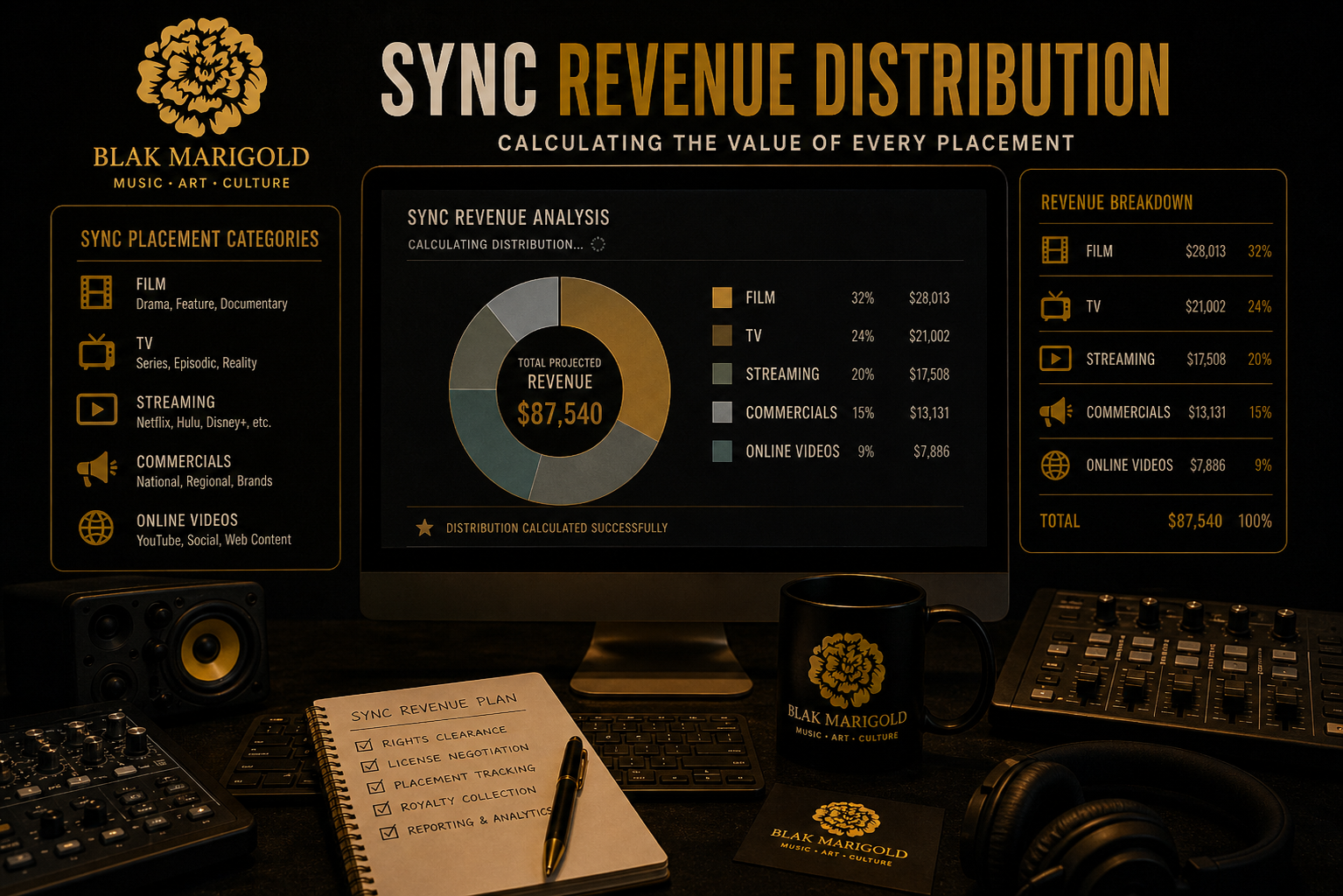
How much do sync placements pay in 2026? The honest answer is that sync fees can range from a few hundred dollars to six figures, depending on the usage, term, territory, media type, artist leverage, and how easy the song is to clear.
For independent artists, TV placements often fall somewhere between the low hundreds and five figures. Indie film placements may start smaller, especially for festival use. Advertising, trailers, and national brand campaigns usually have the highest upside because the music is tied directly to marketing value.
The upfront sync fee is only one part of the money. Artists may also earn backend performance royalties when cue sheets are filed correctly, and the music is tracked by a PRO like ASCAP, BMI, or SESAC.
Use the table below as a realistic starting point, not a guaranteed quote. Every deal depends on how the song is used, how long the license lasts, where it runs, and who controls the master and publishing rights.
Who This Is For
This is for independent artists, producers, and rights holders who are trying to understand music sync licensing as a business, not as a mood board. If you make hip-hop, R&B, pop, cinematic, or production music, and you want a realistic view of music placement income, this is for you. If you are still asking how to get your music placed in TV and film, the money question matters, because it tells you which opportunities are worth chasing and which ones are just noise.
Typical Sync Fees in 2026
| Usage Type | Typical Range | Best Case Scenario | Notes |
|---|---|---|---|
| TV Background Placement | $250 to $5,000 | $10,000+ | Depends on network, duration, prominence, and reruns |
| Streaming Series Placement | $000 to $7,500 | $15,000+ | Backend can vary depending on platform reporting |
| Indie Film Placement | $500 to $5,000 | $20,000+ | Festival rights may start lower, then increase with distribution |
| Trailer Placement | $5,000 to $50,000 | $100,000+ | Trailers often pay more because they are funded with marketing money |
| Ad Campaign | $1,000 to $25,000 | $100,000+ | National campaigns can pay significantly more |
| Branded Social or UGC Campaign | $100 to $2,500 | $10,000+ | Smaller upfront fees, but useful for volume, passive income and relationships |
Table of Contents
What a Sync Placement Actually Pays For
What TV Placements Really Pay
What Film Placements Really Pay
Stop Guessing Who to Pitch Your Music To
What Ads and Brand Campaigns Really Pay
What Streaming and Micro Sync Really Pay
What You Actually Keep After Splits
Recommended Platforms and Tools
What Nobody Tells You About Sync Licensing
Common Mistakes
How to Fix It Fast
Ready To Understand What Your Music Could Be Worth?
FAQs
What a Sync Placement Actually Pays For
Every real sync deal involves at least two rights. One covers the composition, which is the song itself. The other covers the master, which is the specific recording. In many deals, the two sides are priced equally, and in some cases, they are bundled into an all-in license to speed up the clearance process. That is why one-stop clearance matters so much. If a music supervisor can clear both sides quickly, your track becomes dramatically easier to use.
This is also where artists accidentally lie to themselves. If you say, “I got a $10,000 sync,” but you only control one side, or you split the fee with a co-writer, a producer, a library, and a publisher, your real take-home will look very different.
The second thing artists miss is the backend. A cue sheet is the document that tells PROs, such as ASCAP and BMI, what music was used in a film or television program. If that paperwork is incorrect or missing, your backend can be delayed, reduced, or lost. It is not glamorous, but knowing this is the difference between a placement that pays once and a placement that keeps paying.
Sync Fee vs Backend Royalties
A sync fee is the upfront money paid to license your song for use with a picture. This can include TV, film, ads, trailers, games, streaming shows, and online video.
Backend royalties are different. These are public performance royalties that may be paid later when the project airs, streams, or broadcasts in qualifying ways. This is where cue sheets matter.
A cue sheet lists the PROs who wrote the music, the publishers, how long the song was used, and where it appeared. If the cue sheet is missing or incorrect, backend money can be delayed or lost.
That means a sync placement can pay in two ways:
• Upfront sync fee
• Backend performance royalties
The cleanest setup is when your song is registered properly, your splits are clear, and you can quickly confirm who controls the master and publishing.
What TV Placements Really Pay
Published benchmarks for TV are all over the map because TV is not one market. A background cue in a modest unscripted show is not the same as a featured vocal in a network drama. Recent industry guides place TV placements for independent artists roughly between $500 and $10,000 at the low end, while newer artist TV syncs can range from $0 to $5,000, and premium network or streaming uses can go materially higher.
That spread exists for a reason. TV pricing depends on prominence, term, territory, budget, and whether the production wants a full artist record or simple production music from a music library. A brief asking for tension underscore in the background doesn’t assure the same money as a featured end title song. BMI’s television royalty rules also make clear that use type, duration, audience size, and broadcast time all affect backend value. Feature uses, background uses, theme uses, and super usages are not paid identically.
So yes, TV can pay well. But if someone tells you every television sync license is a five-figure windfall, they are either selling a course or forgetting to mention the other 98 deals.
What Film Placements Really Pay
Film money is even more contextual. On the low end, independent filmmakers can often negotiate festival rights first, then step up later if distribution happens. Film Independent says festival rights can often be cleared at around $500 per side, which means about $1,000 all in for master and publishing before anyone starts arguing.
From there, indie film placements often move into the $500 to $2,000 range for smaller projects, then into the mid four figures or higher when the film has real distribution. Broader published estimates put films at around $2,500 to $20,000, while larger studio deals and trailer uses can go much higher.
Trailers are their own beast. They are marketing uses, not just story uses, and that usually means more leverage for the rights holder. Music licensing specialists note that trailer rights are often priced higher than film use because the music helps sell the project, not just score it.
Stop Guessing Who to Pitch Your Music To
Get instant access to 300+ music supervisors, sync libraries, publishers, and licensing contacts. We did the research so you can build your pitch list, submit smarter, and get your music in front of the people placing songs in film, TV, ads, games, and music libraries.
Sync Licensing Bible directory with 300+ music supervisors, music libraries, publishers, and licensing contacts for artists and producers pitching music for film, TV, ads, games, and sync placements.
The Sync Licensing Bible gives artists, producers, songwriters, managers, and indie labels access to over 300 music supervisors, music libraries, publishers, licensing companies, and sync contacts so you can stop searching and start pitching with a real plan.
This directory is designed to save you time, help you stay organized, and give you a stronger starting point for getting your songs in front of people who work with TV, film, ads, trailers, games, and digital media.
Perfect for anyone ready to stop guessing where to send music and start building a real sync outreach system.
Digital download only. No physical product will be shipped.
What Ads and Brand Campaigns Really Pay
Commercials are the category artists fantasize about the most, and for once, the fantasy is not completely delusional. Advertising pays more because the music is directly tied to selling something. The money follows the media buy.
On the smaller end, published benchmarks put local or regional commercial uses from a few hundred dollars into the low thousands. A recent sync guide put advertising at $5,000 to $ 100,000+, depending on scope, while another current guide placed local campaigns at $1,000 to $5,000, regional or digital ads at $2,000 to $25,000, and national television commercials at $15,000 to $250,000 or more.
For recognizable catalog songs, the numbers jump fast. PremiumBeat notes that using a popular PRO-controlled song in a US TV commercial can run roughly $75,000 to $200,000 for one year of national coverage.
That does not mean every ad deal is six figures. It means the ad work has the greatest potential upside and the widest pricing spread. It also means you need your stems and instrumentals ready. CD Baby says instrumentals are nearly always required for advertising, and artists lose placements all the time because they don't have them ready when the request comes in.
There is also a backend. Songtrust uses a simple example: a commercial that generates a $5,000 upfront payment plus additional royalties as it is played or viewed. BMI separately confirms that it pays for music in qualifying broadcast commercials and calculates those payments based on time of day and number of performances.
What Streaming and Micro Sync Really Pay
Streaming makes artists ask the wrong question. They ask whether a streaming show pays as well as a TV show. The honest answer is: Sometimes. Songtrust notes that streaming television royalty practices are still less settled than traditional broadcast, with some services relying on reporting and others on deals that look more like buyouts.
That said, streaming is not a backend desert. BMI now includes a digital audiovisual streaming bonus for popular series and films across major streaming services, and ASCAP has said it expanded premium payments to include top-streamed shows on major OTT services.
On the upfront side, published 2025 and 2026 estimates place streaming show placements for independent artists at roughly a couple of thousand dollars, with high-visibility scripted placements going higher.
Then there is micro sync, which includes user-generated and creator economy uses on platforms such as YouTube. Songtrust describes micro sync as music used repeatedly in videos and Shorts, and says the fee can range from nominal amounts to hundreds of thousands, depending on song popularity and context. It also notes that monetized US YouTube views can generate both performance and mechanical royalties.
In other words, streaming can absolutely pay. It is just less standardized, less romantic, and more admin-heavy than artists expect.
What You Actually Keep After Splits
As enticing as a $5,000 Gross fee can seem, it is not net income. This is where independent artists can get humbled.
BMI says a music library will typically keep 50% of the sync and master use fees it secures, plus the publisher’s share of performance royalties generated by the placement. Songtrust says it charges its standard 15% fee when negotiating sync licenses for clients, while CD Baby says it takes 40% of sync revenue generated through its program.
At the lower end of the market, the math gets even uglier. Pond5 says contributors earn a 30% royalty share on music, and the platform publicly markets stock tracks starting at just $5. That is not a joke. That is a real reminder that not every sync licensing opportunity is a career-changing check. Some are volume marketplace sales, which means your actual payout can be closer to lunch money than rent money.
By contrast, license pricing on stock platforms like PremiumBeat shows how customer-side pricing can move from $59 for commercial web and social use to $199 for non-web advertisement. Those are not artist payouts, but they help explain why open-marketplace fees are usually lower than those for bespoke, supervisor-negotiated placements.
The cleanest money comes when you own both sides, have a publishing split sheet that is already sorted, and can offer one-stop clearance without a panic attack.
Recommended Platforms and Tools
If you are serious about music sync licensing, use tools for their purpose, not by hype. Start with rights and royalty infrastructure. That means a PRO such as ASCAP or BMI, and if you need publishing administration help, a service like Songtrust. None of that gets you creative placements by itself, but it gives you a way to collect what you are owed.
For discovery and research, tools like IMDbPro, the Music Supervisors Directory, and The Sync Report are useful once your catalog is actually ready. If your metadata for sync licensing is weak or your splits are a mess, a contact database is just an expensive way to embarrass yourself faster.
For catalog exposure, open marketplaces and production music library platforms can create volume, but curated sync licensing companies and music licensing companies often have stronger buyer relationships and better fee potential. The trade-off is selectivity and a bigger share of the pie.
What Nobody Tells You About Sync Licensing
The ugliest truth in sync is that the best-paying deal is not always the best career deal, and the smallest fee is not always worthless.
A $1,000 festival use in the right film can lead to wider rights later. A modest TV placement with strong backend and reruns can beat a flashy one-time buyout. A small ad can be useful if it creates a relationship with a music supervisor, brand team, or agency that keeps coming back.
The other truth is simpler. Most artists are not losing sync licensing opportunities because their songs are bad. They are losing because their files are disorganized, their ownership is unclear, and their mix is not broadcast-ready. That is less exciting than the “set for life on a single commercial” dream, but it is also closer to reality.
Common Mistakes
To recap a little bit, there are four mistakes a new artist can make when getting into sync:
The first mistake is confusing a sync fee with total earnings.
The second is quoting gross fee numbers without subtracting splits, library percentages, or admin commissions.
The third is ignoring the backend because it feels slow.
The fourth is pitching music with no clean version, no instrumentals, and no stems, then wondering why nothing lands.
The fifth mistake is assuming every streaming placement pays like a national ad. It does not. Not even close.
How to Fix It Fast
Treat every song like a rights asset. Confirm who owns the composition, who owns the master, and who can sign today. Make sure your publishing split sheet is complete. Register the work. Keep your metadata usable for sync licensing. Print the clean version, the instrumental, and the stems before anyone even thinks to ask.
Most importantly, take your music’s sound quality seriously. If your mix folds under dialogue, or your instrumental feels empty once the vocal is muted, that is not a song fit for a sync catalog; that is a demo track. This is exactly why professional mixing and mastering matter.
Recording Music That Actually Gets Placed
If you are comparing a recording studio Austin artists use for releases, or sifting through the best recording studios in Austin, sync should change what you ask for. You do not just need a good-sounding record. You need broadcast-ready translation, clean edits, stems, instrumentals, and files organized for fast clearance. That is where Blak Marigold fits naturally. The point is not hype. The point is readiness. An otherwise beautiful mix that cannot survive under dialogue is not sync-ready.
Ready To Understand What Your Music Could Be Worth?
Sync licensing can pay well, but only when your catalog is organized, your rights are clear, and you know who to pitch.
The Sync Licensing Bible provides independent artists with a practical starting point, featuring 300+ music supervisors, sync libraries, publishers, and licensing contacts. It also includes pitch email templates and a Sync Rate Cheat Sheet so you can better understand what different opportunities may be worth before you submit.
Step 1: Download the Sync Licensing Bible.
Step 2: Use the Sync Rate Cheat Sheet to understand pricing ranges.
Step 3: Build your pitch list and start submitting smarter.
FAQS
-
A sync placement is when music is paired with picture in TV, film, advertising, games, or online video, usually through separate master and publishing clearances.
-
A typical sync fee can range from a few hundred dollars to thousands of dollars depending on the placement type, usage, term, territory, and how prominently the song is used.
-
Yes, artists and songwriters may earn backend performance royalties when cue sheets are filed correctly and the placement airs, streams, or broadcasts in qualifying ways.
-
For independent artists, common published ranges cluster from about $500 to $10,000, while premium or highly featured uses can rise higher.
-
Ad sync placements can range from low thousands to six figures depending on whether the campaign is local, regional, digital, national, or global.
-
Because the music is directly tied to marketing value and media spend, ad rates often outpace editorial uses by a wide margin.
-
The biggest factors are usage type, song prominence, term length, territory, media budget, exclusivity, artist leverage, and whether the song is easy to clear.
-
The sync license clears the composition. The master license clears the actual recording. Real placements usually need both.
-
You control both revenue sides of the deal, which can mean the full all in fee lands with you before any rep or admin deductions.
-
Fit, speed, and clean clearance. A great song with messy rights is often less useful than a very good song with instant one stop clearance.
-
Extremely important. It affects discoverability in every music library and production music library search. If the data is weak, the track is effectively invisible.
-
Yes. Artists often lose placements because they do not have them ready, and advertising often requires instrumentals.
-
Cue sheets are the main documents PROs use to identify uses in film and television, so missing or inaccurate sheets can delay or reduce royalties.
-
Yes. Individually they may be small, but Songtrust notes they can generate both performance and mechanical royalties in monetized uses.
-
Sometimes very little upfront. Open marketplaces can price music at stock levels, which is why take home depends heavily on splits and volume.
-
It varies widely. BMI cites 50% for many library deals, Songtrust charges 15% when it negotiates syncs, and CD Baby takes 40% on placements it secures.
-
They can be. Small commercial uses may only pay hundreds or low thousands, but they can still create relationships and repeat work.
-
Sometimes. Union agreements can create separate session and reuse payment structures for performers beyond the sync fee paid to rights holders.
-
Indirectly, yes. A professional recording studio for sync music helps you deliver release quality mixes, clean masters, and usable alternates, which is what supervisors actually need.
-
Because a weak mix falls apart easily when paired with dialogue, sound effects, and broadcast playback. In sync, technical readiness is part of the creative pitch.
-
Ownership, publishing split sheet, PRO registration, metadata, instrumental, clean version, stems, contact info, and confirmation that the song can clear immediately.